You can complete your full 2026 business strategic plan using affordable AI tools in just a few hours. This guide shows you exactly how, with step-by-step instructions, realistic timeframes, and cost breakdowns.
When you're focused on immediate tasks, strategic planning often gets pushed aside. This year, AI changes that. Instead of weeks of planning work or expensive consultant fees, you can research your market, forecast revenue, and build your strategy in a single week using tools that cost less than $100.
More than 95% of NZ small businesses using AI report revenue growth. Another 93% say their teams became more efficient. Imagine getting these productivity gains yourself!
The New Zealand Government's AI Strategy projects AI could add $76 billion to the economy by 2038. Small businesses that adopt AI now position themselves to benefit from this growth. The value is real.
We know adopting new tools feels risky. But the truth is, waiting is riskier. Businesses that delay fall behind faster than those who start now.
Here's the good news: you don't need technical skills, a large budget, or a data science team. Most AI tools are designed for everyday business owners like you.
Why 2026 is the right time to adopt AI for your business planning
Your business is probably ready to use AI for strategic planning sooner than you think. Check if you’re ready to begin.
Are AI tools cost-effective for a small business?
Five years ago, strategic planning tools cost tens of thousands of dollars. Today, you have options:
- Free or low-cost AI chat tools such as Chat GPT or Copilot (for research and analysis)
- Affordable AI spreadsheet assistants ($30 to $50 per month)
- Low-cost document and planning tools ($10 per month)
Most small businesses set up AI for a fraction of what you'd pay a planning consultant.
Are your competitors already using AI?
Right now, 82% of NZ organisations are using some form of AI. If you delay, you’ll find yourself falling behind. Businesses that start using AI now can spot opportunities faster, run operations more smoothly, and make better decisions ahead of their competitors.
How does AI speed up your planning process?
Market research, financial forecasting, and planning used to require hiring consultants or spending weeks in spreadsheets. Not in 2026. Now you ask an AI tool a question in plain English and get answers in seconds. This frees up your time for the decisions only you can make.
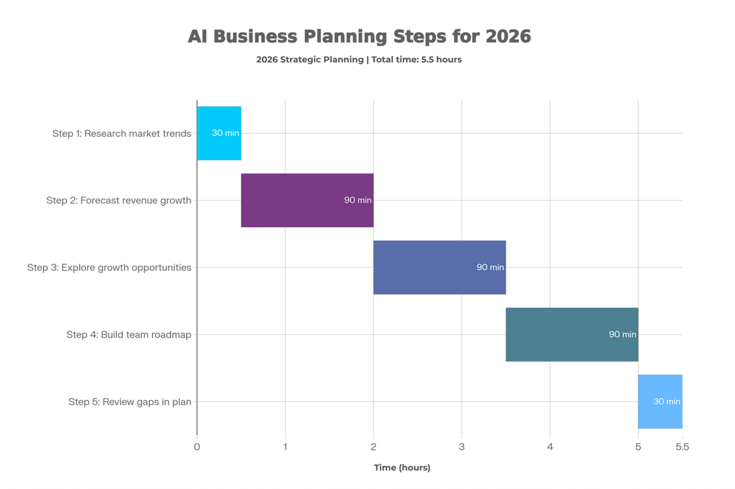
How to plan your 2026 business strategy with AI in five steps
Step 1: What are the top five market trends for your 2026 planning? (30 minutes)
Ask a free AI chat tool to research your industry, competitors, and what's changing. Start with these questions.
- What are the top five trends in [your industry] in 2026?
- Where are new opportunities emerging in [your market]?
- What are [competitor name]'s main strengths and weaknesses?
The AI pulls together information and gives you a summary you can use to spot where your business could grow. It works fast. You're not replacing your own thinking, but you’re speeding up the research so you can focus on deciding where to put your energy.
Step 2: How do you forecast revenue growth for 2026 with AI? (1 to 2 hours)
Use an AI spreadsheet tool or AI chat tool to test different revenue possibilities for 2026. Give the AI your current numbers and prompt it to analyse them.
- Show what revenue could look like under three different situations: conservative, realistic, and growth-focused.
- Identify which expenses stay the same and which change.
- Show how changes in pricing, volume, or new products affect your profit.
This kind of work used to need a financial analyst. Now you get multiple options to explore. You can see which decisions make the biggest difference to your bottom line and plan accordingly.
Step 3: Which growth opportunities should you explore for 2026? (1 to 2 hours)
The New Year brings opportunities and changes. Use AI to explore different ways you could grow and run more efficiently.
- If we moved into [new market or product], what would we need?
- How would raising prices affect our customers and revenue?
- What would it take to run 15 to 20% more efficiently this year?
This helps you decide where to focus energy for the biggest results. Instead of assuming everything stays the same, you're actively exploring which options make sense for 2026 and what you'd need to make them work.
Step 4: How will you build your team roadmap for 2026? (1 to 2 hours)
Create a document that puts your 2026 plan in one place, so your team knows what's happening and why.
- Put together your market research, growth opportunities, and financial forecasts in one place.
- Create clear action plans with owners assigned to each priority.
- Set quarterly milestones and review dates so everyone stays aligned.
A written plan keeps your team moving in the same direction and makes it easier to track progress through the year. When people understand the bigger picture and their role in it, getting things done becomes smoother. Clear communication also prevents misunderstandings and supports a more productive workplace.
Step 5: What gaps might you miss in your 2026 strategic plan? (optional, 30 minutes)
Before you launch your strategic plan into 2026, take a step back and check it makes sense.
- Are your growth ideas realistic based on what you know about your market?
- Have you thought about all the resources you need (people, budget, time)?
- Are there any gaps or opportunities you've overlooked?
You can do this review with your leadership team. For an outside perspective and someone to keep you accountable, register with a Business Mentor. Their experience is invaluable for thinking about your strategic planning and staying on track through the year.
2026 Business Planning with AI: 5 Common Challenges & Solutions
Why don't I understand how AI works? (And why that's okay)
More than 50% of business leaders admit they don't fully understand AI. This is normal. You don't need to understand how a car engine works to drive it. It's the same with AI.
Start with one tool for one specific task. Most AI tools work like texting a friend. Most business owners feel confident using them after an hour of practice.
Is my business data clean enough for AI to work?
AI tools work best with good data. If your financial records are incomplete or your customer data is messy, AI outputs will reflect that.
Spend a few hours cleaning up your most important data before you start. Focus on financial records and customer information first.
Will your team resist AI adoption?
Your team might worry about job security. Be clear: AI helps with analysis and research, but people make decisions and execute the plan.
Frame AI as a tool that frees people from repetitive data work so they can focus on higher-value work that drives your business forward.
Will AI work with your existing systems?
If you use accounting software or payroll systems, you can often connect these to AI tools. Connecting them isn't always smooth.
Check whether your systems work together before you commit to a tool. Test connections with free trials first.
Common questions about AI planning for your 2026 business year
Q: Do I need technical skills to use AI for 2026 planning?
A: No. AI chat tools work like texting a friend. You write questions in plain English, and the AI responds. Most business owners feel comfortable using them after about an hour of practice.
Q: Is 2026 business planning with AI suitable for small New Zealand companies?
A: Yes. AI planning tools are specifically designed for businesses without large budgets or data teams. In fact, 82% of NZ organisations are already using some form of AI. Small NZ companies that start 2026 planning with AI now gain a competitive advantage, access to analytical power previously available only to larger firms, and can complete strategic planning in days instead of weeks.
Q: How much will it cost to use AI for my 2026 planning?
A: Many tools are free or cheap. Free AI chat tools are available, spreadsheet AI tools start around $30 to $50 per month, and planning tools cost $10 per month. A typical small business spends under $5,000 to set up AI for annual planning.
Q: How much time will 2026 business planning with AI actually take?
About 5-6 hours total across a few days. This breaks down to 30 minutes for market research, 1-2 hours for revenue forecasting, 1-2 hours exploring opportunities, 1-2 hours for team planning, and 30 minutes to review. You can spread these across a week or compress into one long day. Traditional planning takes weeks of meetings and consultant time, so this is significantly faster.
Q: Can AI really help me spot growth opportunities for 2026?
A: Yes. AI is particularly good at pulling together information about market trends, what competitors are doing, and new opportunities. What it can't do is decide which opportunities matter most for your business. That's where you come in.
Q: What's the biggest mistake NZ small businesses make with AI?
A: Waiting too long. With 68% of NZ small businesses having no AI plans, businesses that start now get real advantages in understanding their market, planning effectively, and executing faster. Start small with one tool and one task. You'll learn as you go.
Q: Should I use a Business Mentor to help with my 2026 plan?
A: Yes. A Business Mentor can review the strategic plan you generate with AI. They’ll help you make sure it's realistic, spot opportunities you might have missed, and keep you accountable to executing it through the year.
Build your 2026 plan with confidence
With 2026 business planning using AI, NZ small businesses now have access to analytical power that was previously available only to larger corporations. Your strategic plan doesn't have to be expensive or time-consuming. Go for a plan that’s clear, practical, and ready to execute in just a few hours so it really happens.
Ready to build your 2026 plan with confidence? Find a Business Mentor that ‘gets’ your business and can review your strategy, spot opportunities you might have missed, and keep you accountable through the year.
.jpg)
.jpg)

.jpeg)