.jpg)
AI tools have progressed at lightning speed. Keeping up means being deliberate and curious. Below you'll find a few ideas to ensure you're staying ahead.
This article pulls together the most useful information available right now, so you can make clear-headed decisions for your business.
See how much has changed
When AI tools launched in late 2022, it was impressive but limited. It couldn't browse the internet or analyse images, and often got basic facts wrong. Today's AI tools are a different story. You can show it a photo of a handwritten notes and it will type them up. You can paste in your monthly sales figures and ask it to spot a trend. Text, images, code and data can all be handled easily in the same conversation.
Importantly for small NZ business owners tools that once required technical know-how are now easily accessible even if you don’t have technical knowledge or lots of spare time to use them. In fact, many of the most useful AI tools in 2026 work the way good staff do: you tell them what you need, they get on with it, and you check the result.
Pick the area that will save you the most time
The quickest way to get value from AI is to match it to your biggest time drain. Here are five areas where NZ small business owners are already seeing results:
- Writing and communications tasks such as drafting customer emails, creating social media posts, developing proposals, or updating website copy.
- Taking meeting notes to produce summaries with action items.
- Improving marketing content for better email subject lines and send times
- Researching and planning with AI as a tool to summarise industry changes, compare suppliers, or draft a business plan outline.
- Supporting customer service with AI-assisted chatbots to handle frequently asked questions around the clock.
You can start with just one area where you most feel the pinch and run a small experiment. If it saves time, make it a habit.
Aim for AI fluency, not just AI literacy
AI literacy and AI fluency are not the same thing and understanding the difference will shape how you approach your own development.
AI literacy means you understand what AI can and cannot do, you know when to question its outputs, and you recognise when human judgement must take over. AI fluency goes further. A fluent user knows when to use AI tools and when not to, and how to critically evaluate what comes back. Fluency shows up in delegating the right tasks to AI, writing prompts that get genuinely useful results, and spotting errors or bias before they cause a problem.
For business owners, its fluency that gives you a real edge. A useful way to structure your thinking is the four-competency framework used in AI training.
- Delegation: deciding when AI is the right tool for this task
- Description: communicating clearly through prompts
- Discernment: evaluating what AI produces critically
- Diligence: using AI responsibly and staying accountable for the result
These four skills build on each other and they apply whether you're writing a customer email or forecasting next quarter's cash flow.
Build your own AI rubric
One practical tool is a personal AI rubric. This is a framework you create to measure and lift your own competency over time.
The first step is to define a handful of skill areas that matter for your business, such as writing prompts that produce reliable results, evaluating whether an AI output is accurate and even knowing when not to use AI. For each area, you describe what progress looks like. Here’s an example you could start with.
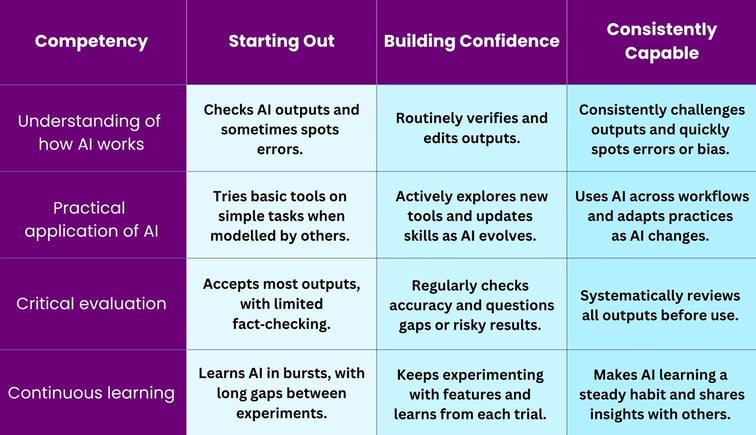
The rubric isn't a one-time exercise. Your skills and AI capabilities shift quickly. Revisiting it every few months keeps your development connected to what's actually happening in your business.
Stay curious: make learning a regular habit
Keeping up with AI is less about being tech savvy and more about being curious. Taking a few minutes each week may help you spot a feature that didn't exist six months ago that can now solve a problem you've had for years.
Here are a few further ideas to keep learning achievable with bite-sized chunks.
Follow one trusted source
Business.govt.nz has a guide on getting started with AI that is regularly updated. The AI Forum NZ publishes regular reports on how NZ businesses are using AI.
Ask your team
Most Kiwi workers already use generative AI to some degree. Your staff may already have found tools that save them time so a quick conversation could surface something useful.
Try the NZ Government's AI Advisory Pilot
The Government has expanded this programme to support up to 150 NZ small businesses, offering co-funding of up to 50% (capped at $15,000) to develop and implement an AI plan. The AI Advisory Pilot runs through the Regional Business Partner Network until January 2027.
Set one simple rule for your team
If you have staff, it's worth having a brief conversation about how your business uses AI, not to restrict it, but to make it work better. A simple one-page policy covering what's okay, what to be careful about, and how to check AI outputs before they go to customers is enough to get started.
The key things to cover:
- Don't share sensitive data (customer details, financial information) in free public AI tools.
- Always check the output before it goes to a customer or gets used for an important decision because AI can sound confident even when it's wrong.
- Keep a person responsible. Business.govt.nz calls this the ‘Human in the Loop’ model: a real person is always the final decision-maker.
This isn't about being cautious for its own sake. It's about making sure the efficiency gains you get from AI don't create problems elsewhere.
Get a sounding board
Working out where AI fits in your specific business is easier with someone who knows your situation. A Business Mentor can help you identify the highest-value opportunities, sense-check what you're doing, and connect your AI experiments to your broader goals.
Business Mentors New Zealand has recently introduced two new AI-powered tools of its own: the Mentoring Assistant, which helps mentors capture and organise discussions from sessions, and the Digital Mentor, which gives 24/7 access to business advice on strategy, finance, and marketing, to name a few areas. Your mentor is working with this technology too, which means the conversation is more relevant than ever.
.jpg)
.jpg)

.jpeg)